
This title of this song has always appealed to me: evocative, esoteric and apocalyptic, it is one of the more baroque examples in the Spoon catalog. The song itself, though, I've always felt is somewhat middle-of-the-pack, interesting for the way it steadily builds an atmosphere of dread, but ultimately just somewhat lacking in vitality.
"Beast" establishes Gimme Fiction's repetition-fetish immediately: for most of the song, Spoon stretches out a simple, ominous minor-key chromatic piano progression into a half-speed dirge. Major-key choruses attempt to deliver a release sufficient to match the verses' continuous tension-build (amplified by Britt's strangled guitar salvos, like miniature car collisions), and the second chorus succeeds a bit with its little extension/variation on the initial chord progression. However, the slightly oppressive lethargy of the song is never fully counterbalanced by Britt's vocal performance, and the song has conspicuously few enlivening melodic flourishes by the band. Is it horrible? Not by any means. The end result just comes off as just the slightest bit... well, dull.
At the very least, though, "Beast" does serve as an interesting and relatively effective album opener: an unsettling call-to-arms ('when you don't feel it, it shows, they tear out your soul; and when you believe they call it rock-and-roll') that also functions as a sort of overture and scene-setter for the album (this theatrical, song-as-album-prelude/overture notion is reinforced by the song's lyrics, which reference two later songs, "I Summon You" and "Never Got You").
Saturday, April 4, 2009
The Beast and Dragon, Adored [Spoon Feeder: Vol. 5]

Tuesday, March 3, 2009
I Turn My Camera On [Spoon Feeder: Vol. 4]
Kill the Moonlight was a breakthrough album for Spoon, and part of that success can be attributed to "The Way We Get By", arguably the first song by the band to gain traction beyond their fan base as a "hit" single, at least in the limited sense that a song released on Merge Records can be a "hit". Earlier songs might have had the potential to make this broader mark ("Car Radio", for example, released on a major label itself, ironically), but predated the song-centric age of the mp3-internet and the burgeoning expansion of Indie to the point where it had its own sort of pseudo-mainstream centralization (as a side note/tangent, you could argue that England, a more culturally and geographically compact country, had this structure long before us, but that it took the Internet to create the same sort of phenomenon in the sprawling American continent).
Each Spoon album since then has had at least one single of obvious and immediate appeal; on Gimme Fiction, "I Turn My Camera On" fits this bill, and it's easy to see why. This is a song built for immediacy: with its limber octave-hopping, tick-tock tension bounce and Britt's pure falsetto coo lead vocal spinning mundane nonsense into catchy, spunky nonsense (as many great pop songs do), it is Spoon's most obvious attempt to adapt crowd-pleasing dancefloor tropes to their sparse idiom, all played at three-quarters speed for extra sonic separation, Kill the Moonlight-style. Speaking of which...
Stylistic novelty aside, the song is also interesting for how it neatly provides a bridge of sorts from Moonlight, maintaining the airy, negative space and immediacy of that album, but also displaying the structural simplicity and groove-focus so characteristic of Fiction, an album which has less of the tidy, rapid shifts between ingenious melodic parts and rhythmic sections that characterized its predecessors. Instead, Fiction finds Spoon often exploring prolonged insistence on a single rhythmic or melodic motif, building ominous tension to points of controlled release (see "The Beast and Dragon, Adored", "My Mathematical Mind", "Never Got You"), or developing percussive chants of zen-like focus ("Was It You?", "Camera", "Merchants of Soul"). Fiction's reliance on repetition is probably one reason why, for many, it remains less accessible and immediate than its nearest siblings.

Sunday, March 1, 2009
Decora [Spoon Feeder: Vol. 3]
A cover song can be a redundant nonentity, rock stars playing dress up as other rock stars, churning out a sloppy, blurred carbon copy; kudos to Spoon then for approaching others' compositions with the same enlivening creativity and minimalist rigor that they do their own.
Yo La Tengo's "Decora" evokes a hazy sort of slacker grandeur: narcoleptic vocals, slurred lead guitar slashing, simple bass quarter notes and a steady, simple drum thump. It's an endearing (if aloof) little song that ambles its way on-stage, taking its time getting where its going.
Spoon's cover extracts the nugget of tasty melody at the heart of the original and moves it to the forefront. Where the original plays hide the ball, burying its charms under a smoke screen of distortion and ambient guitar effects, Spoon lays all its cards on the table from the get go: Spoon's "Decora" begins with that distinctive (and entirely of their own creation) guitar-bass call and response riff, soon joined by an equally distinctive double tap-hiccuping drum beat. As on their other prominent cover, "Don't You Evah", Spoon seems here to have used the original song as a theoretical starting point, and put faithfulness secondary to tunefulness (as all good covers should); notice inspired details like the guitar and bass synchronizing after the first chorus.
Eventually the song edges closer to the original territory at the wordless, swirling choruses, but notice how within the first ten seconds the entire basic skeleton for Spoon's version of the song is introduced and defined: a spry, punchy, rhythmically engaging and witty translation; in otherwards, a Spoon song.


Thursday, February 19, 2009
Loss Leaders [Spoon Feeder: Vol. 2]
This is the second installment of "Spoon Feeder", a [hopefully] regular feature wherein I examine, dissect and reflect on selections from the vast and spectacular Spoon catalog.
1997's Soft Effects EP was released only eight months or so after Spoon's debut LP, Telephono, and it is a striking document of the rapidity of the band's maturity. Telephono was a spiky, abrasive, confrontational record; the polished pop tastefulness that Spoon is now synonymous with peeked out here and there amidst the buzz and crash, but for the most part it was still somewhat buried under post-Pixies squall and post-Pavement squalor. That roughness did not disappear on Soft Effects (and indeed remains part of the band's arsenal), but the elevation in songwriting consistency is still remarkable, and the textural and stylistic diversity of the wide-ranging EP must have at the time suggested that there few limits to Spoon's ability to manipulate indie rock forms into fresh and exciting shapes: we have the majestic crash of pocket-epic "Mountain to Sound", the jaunty pop of "Waiting for the Kid to Come Out", the low-key drone-pop of "I Could See the Dude", and the dark, sinister, sensual fuzz-rock churn of "Get Out the State".
And then there is "Loss Leaders". One of the last Spoon songs I discovered in my time spent trawling back through their catalog, the EP-ender is still a sentimental favorite. "Loss Leaders" is a bright, fresh-faced, unabashed pop song, bursting with the sparkling jangle of Daniel's guitar (Rachel noted the superficial resemblance the song bears to 90's alterna-rock, a la Gin Blossoms; in this vein see also: "Sister Jack"). As an early instance of particularly excellent work, you can hear in it the blueprint for future successes, the Spoon road map to pop-domination. To wit:

1. For a band who operates with such high standards of craft, Spoon has always done a great job adding little bits of in-studio dialog, or snatches of pseudo-improvised guitar strums or drum hits etc., as if surreptitiously captured in studio sessions as the tapes rolled. The little guitar fumbling on the intro to this song is a lovely example. All these thoughtful little details infuse Spoon songs with an approachability and an tangibility, make them feel more organic, more human, less like hermetically-sealed pieces of artifice.
2. Britt Daniel has a very distinctive approach to guitar-work; I remember reading somewhere that he basically thinks he is a poor guitar player, but he sells himself short: he plays like a true songwriter. His guitar playing is extremely compositionally-driven, with a strong melodic sense, and his playing is always rhythmically dynamic and interesting (in fact you could say he expertly straddles the line between rhythm and lead guitar playing), no matter that his parts would pose little challenge to a guitarist of even moderate skill. His signature style is showcased on "Loss Leaders": note the brash open-strumming chords of the verses, ever-fluid with their continuous little hammer-ons; note the echo-y chirping guitar stab-and-slides that balance against solemn single downward strums in the pre-chorus; note the highly melodic and utterly simple guitar picking in the muted instrumental chorus; note the dramatic palm-muted strums that lead us back from that pensive section back into the wide-open glory of the verse again; note the lyrical pseudo-solo that issues forth during the last instrumental chorus/outro. The three minutes and thirty seconds of "Loss Leaders" pass quickly. It can be easy to miss Britt Daniel's guitar pouring out all these volumes of musical wit.
3. Perhaps Spoon's core asset is Britt Daniel's voice and delivery; he is a master at coming up with muscular vocal hooks, and is particularly good at keeping his cadences and vocal rhythms dynamic and punchy; notice how in "Loss Leaders" he chops up his syllables in a percussive staccato manner in the first section of the song, then stretches out his notes into a scratchy-throated croon for maximum effect in the next. Also, as the lovely wordless refrain of "Sha-no-my" (roughly) displays, he is adept at creating catchy little non-word vocalizations in the grand pop tradition of shoo-be-doo's and koo-koo-ka-choo's. As seen in his guitarwork, his melodic sense, his taste for what works, is incredibly consistent.
4. Also, the intonation and delivery of Daniel's vocals tend to do the lion's share of the emotional work in Spoon's songs, as his lyrics can sometimes be obscure, indiscernible, or mundane. This is true of "Loss Leaders": although the first line is classic Spoon meta-lyricism, an ode to the sheer joy of making music ("I get up and all I got on my mind is thinking up brand new chords"), what follows is apparently about the murder of Chicago-area Black Panthers leader Fred Hampton in 1969 (?!?). Definitely noConveniently, Britt Daniel's impassioned slurring can, as here, often increase the impact of his vocals by reducing their clarity; in their ambiguity, the emotional undercurrent of the backing music and vocal delivery are heightened.
5. Though their contributions are usually less obvious than Britt Daniel's, drummer Jim Eno and bassist (until 2007) Joshua Zarbo, provide solid rhythmic support, steady and emphatic, and contributing a few little unobtrusive but engaging musical flourishes that great rock rhythm sections utilize to maximize the listenability of the song (for an example of a rhythm section that takes this technique to a near-absurd extreme, dangling at the edge of excess and yet still manages to still sound fantastic, see Carlos D and Sam Fogarino of Interpol). Some flourishes of note: the little off-time bass riff at each second iteration of the pre-chorus "Sha-No-My"; Jim Eno's tight little stuttering fill at 0:56.
But what helps make this song a personal favorite is not just its mastery of pop form and structure: after all that criteria would sweep in a great many Spoon songs. No, what deepens my affection for the song is its undercurrent of longing, detectable to a small degree from those very first plaintive, false-improv intro guitar notes. The boisterous verse manages to shade over a great deal of that sentiment (though once aware of the emotion's existence, the contrast arguably enhances the effect), but something in the particular vector of the verse vocal melody nevertheless bears it through, until we reach the achingly melancholy prechorus and chorus, and it rises to the forefront again. "Loss Leaders" is thus a peculiar alchemy of revelry and regret, somewhat like looking through old photo albums filled with smiling young faces, and being touched by that old joy, yet simultaneously recalling loneliness between those moments that went uncaptured by any camera. The evocation of this blissful, nostalgic ache is what gives "Loss Leaders" its powerful appeal, and secures it pride of place as a standout in the stellar Spoon catalog.
Sunday, February 15, 2009
Everything Hits at Once [Spoon Feeder: Vol. 1]
This is the first installment of "Spoon Feeder", a [hopefully] regular feature wherein I examine, dissect and reflect on songs from the vast and spectacular Spoon catalog.
In 2001, Spoon was coming off the hangover of a major-label sign-and-drop debacle with Elektra Records. Picked up by the label as they were on the rise, they released the magnificent A Series of Sneaks to commercial ambivalence. Agreements and promises apparently went breached and unfulfilled and Spoon was dropped from the label (a tumultuous time out of which emerged the excellent Agony of Laffitte EP, their musical kiss-off to Elektra, and Elektra A&R man Ronn Laffitte in particular). Older, and we can perhaps speculate, somewhat wiser from the experience, they released Girls Can Tell.
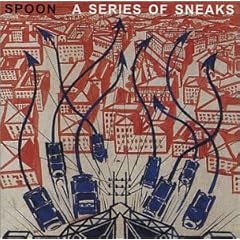 Girls Can Tell marked a new phase for Spoon. Its predecessor, 1998's A Series of Sneaks was an incredibly lean and muscular collection of tightly-wound indie rock. The album has a dry, even dusty sort of sparseness to it; even at its most anthemic ("Car Radio", "Utilitarian", the sublime "Advance Cassette") it sounds shambling, skeletal. Furthermore, despite its innovative, extra-terse songcraft, it had a fairly direct sound and instrumentation that placed it directly in the 90's mainstream American Indie lineage of the Pixies, Pavement, etc.
 Girls Can Tell finds Spoon fully embracing an older vein of rock tradition: the supple grooves of 60's R&B, Motown and Blue-Eyed Soul (a vein they first explored on 2000's extremely strong Love Ways EP). From the very first bars of "Everything Hits at Once", Girls Can Tell's opening track, Spoon's broadened musical arsenal is on display.
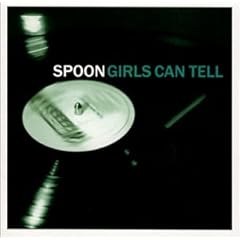 "Everything Hits at Once" exemplifies a particular type of smoky, minor-key Spoon song that can aptly be called noir-pop. It doesn't forgo the compositional brilliance displayed on A Series of Sneaks; it maintains an uncanny sense of song architecture, the deft deployment of melody around a dynamic rhythmic core, but in its deeper, echoing production and expanded instrumentation, all chiming keys and fluttering mellotron, the song exemplifies its album's cooler tonal palette. Girls Can Tell is, on balance, a rather nocturnal album, and "Everything Hits at Once" is the album's overture: it captures the sound of coasting through the city at night, riding the insistent pulse of a sleepwalking metropolis in a dream-like haze, wandering to escape some regret, or nurse some deep, lingering wound. A persistent undercurrent of gentle longing emerges from every corner of this song, but perhaps most brilliantly from the four-note mirrored sighing piano and guitar lines that ascend repeatedly over the chorus; ah, but then there's the lovely bridge as well, with its see-sawing call and response mellotron bursts; ah, but also the lovely, ethereal fade out, haunted by Britt Daniel's ghost-like coo...
 In the end, as with many of Spoon's best songs, there are many "best" moments, and it is hard not to underline nearly every detail of "Everything Hits at Once" for the high degree of its craft and the class evinced in its execution.
Sunday, April 20, 2008
Here's to you, Britt Daniel.
Exquisitely tactful vocalist, unerringly consistent songsmith, and all-around awesome frontman Britt Daniel, you deserve every accolade you receive and so much more.
Ok, I'll admit, Spoon is my favorite band. My music taste has somewhat of a formalist slant. I appreciate expansive creativity and avant-garde boundary pushing, sure, but I really have a soft spot for musicians and artists who can artfully manipulate the formal constraints of classic pop and rock songwriting structures and assemble them into new, exciting and timeless shapes.* Spoon is a perhaps peerless example of such a band.
I heard recently that Matthew Perpetua of Fluxblog fame has a project to review one R.E.M. song every day for a year or something (and that Floodwatchmusic , another great blog, is doing the same for Rush(!)). Maybe I'll anatomize Spoon's catalog as well. I'd love to set out in clear and rational terms, with all the evidence I can muster, why I believe them to be truly (one of) the greatest band(s) of our generation.
*As an aside, I think the same sort of logic explains why I love "Ocean's Eleven"; the movie takes a familiar theme and and executes it with such wit, class and restraint that the end result has a transcendent sort of breezy magic, channeling the charisma and glamor of Old Hollywood.
